Thinking about using Taxy?
Here’s what firms usually ask.
Understanding Taxy
What does Taxy actually do?
Taxy makes building, sending and tracking client information requests for tax returns much faster and less frustrating.
The platform gives accountants and their clients one place to collaborate instead of managing requests across multiple tools.
As responses come in, teams can see in real time what has been returned and what is still outstanding without needing to piece together where the job is up to.
How is Taxy different from using email or a client portal?
Clearer requests: personalising requests manually is difficult, but generic email templates lead to slow and incomplete responses.
A better client experience: portals are designed for document storage, not client collaboration or tax-specific workflows.
Greater visibility: teams can see at a glance what has been returned and whether a job is ready to be picked up.
Where does Taxy fit in the tax return process?
Taxy supports the early stages of a tax return job from building a client request to the point at which the return is prepared.
Because a large portion of tax return work involves collecting and clarifying information, improving this stage helps teams move through returns more efficiently.
Is our information secure in Taxy?
Yes. Security is core to Taxy.
All data is encrypted, stored in Australia, and only accessible to authorised users in your workspace.
If you’d like more information on our security and data handling practices, please contact us.
Getting Started
How long does it take to get started with Taxy?
Your first request can usually be sent within a few days. The hardest part is often choosing the first client to test with.
Most teams evaluate the time savings by running Taxy alongside their existing process. This shows how it works in practice in a low-risk, low-effort way.
Does getting started involve a big implementation?
No. Rather than rolling Taxy out across the whole practice before knowing if it will save time, most new customers start with one multi-entity client group and run a proof of concept.
Once teams see how much time is saved managing requests and follow-ups, they naturally add more of their clients to the platform over time.
What do we need to do before sending our first request?
Very little. You simply choose a client you want to test Taxy with and provide us with any existing request templates you have. We load these into the platform for you.
In most cases, new customers choose a client and spend around 30 minutes with our onboarding team before inviting their first client to Taxy.
What does the onboarding process look like?
If you decide to roll out Taxy to more clients, our team runs a kick off call and ensures any manual effort sits with us, not you.
You’ll provide us with some basic client information (securely) and the system does the heavy lifting to put a draft request together for you to review before sending out in your own time.
Client Experience
What do clients see?
Initially, clients receive an invitation to access the platform securely.
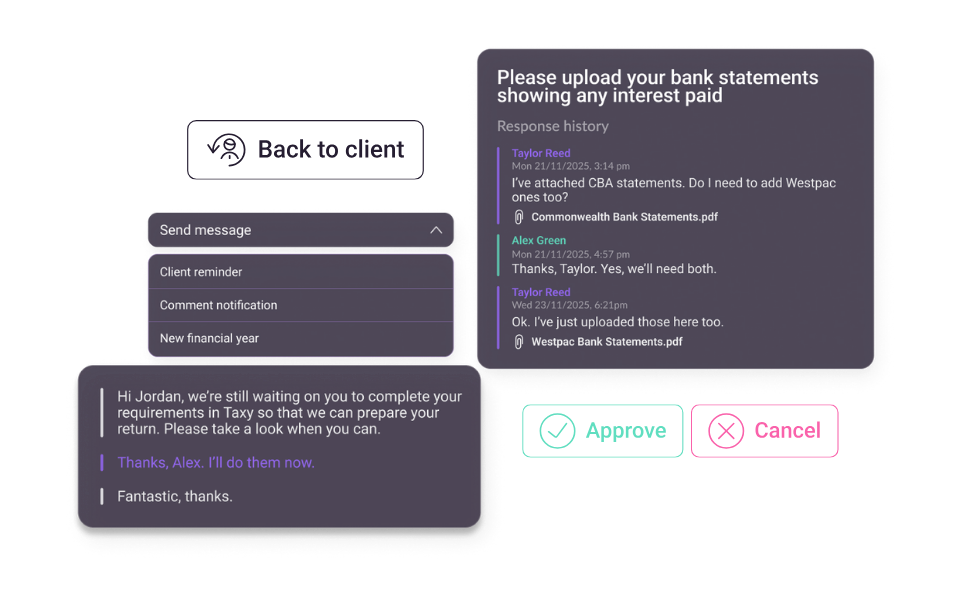
From there, they’re guided through your request, broken down into small, manageable worklist items with response fields and upload facilities for each.
Do clients struggle to use Taxy?
While introducing new technology to clients should be carefully considered, even our most sceptical customers have found their clients love using it.
We’ve found that compared to the alternatives Taxy is more user-friendly and reduces confusion, resulting in happier clients.
How do clients know what’s still outstanding?
Status indicators clearly show which items still require a response and which they’ve sent back. Once an item has been returned, it disappears from the clients worklist, but they’re always able to access historic requests and answers.
Workflow & Visibility
How does Taxy help track outstanding requests?
The dashboard provides a clear view of how many items have been returned and which are still outstanding for each client.
As clients respond, progress updates automatically. This makes it easy to see where each job is up to and follow up on missing information without piecing together emails or notes.
Can we customise requests for different entities or jobs?
Yes. Tailoring requests is one of the ways Taxy reduces the back-and-forth that comes with generic email requests.
Templates are built around common requirements, but each request can include a different combination of questions and documents depending on the client or entity. Templates can also be updated at any time as your processes evolve.
What happens after a client responds with everything?
Once the full request has been returned, you can start preparing the return in your lodgement software.
Taxy gives you confidence that the information supporting the return is organised in one place and easy to access during final review.
Email wasn’t built for modern tax workflows.
See what is.
When you meet with us, it’s not just a demo.
We’ll show how firms like yours adopt Taxy within their existing workflows and start seeing value quickly—without a long and risky implementation project.